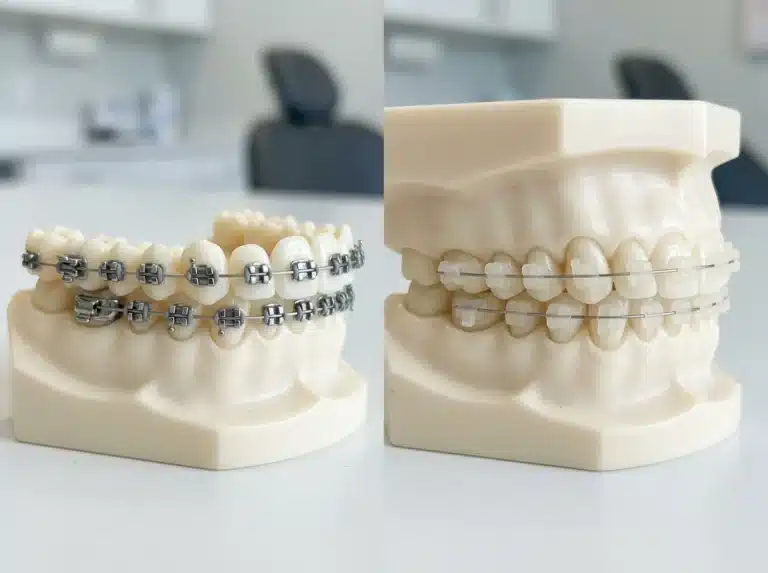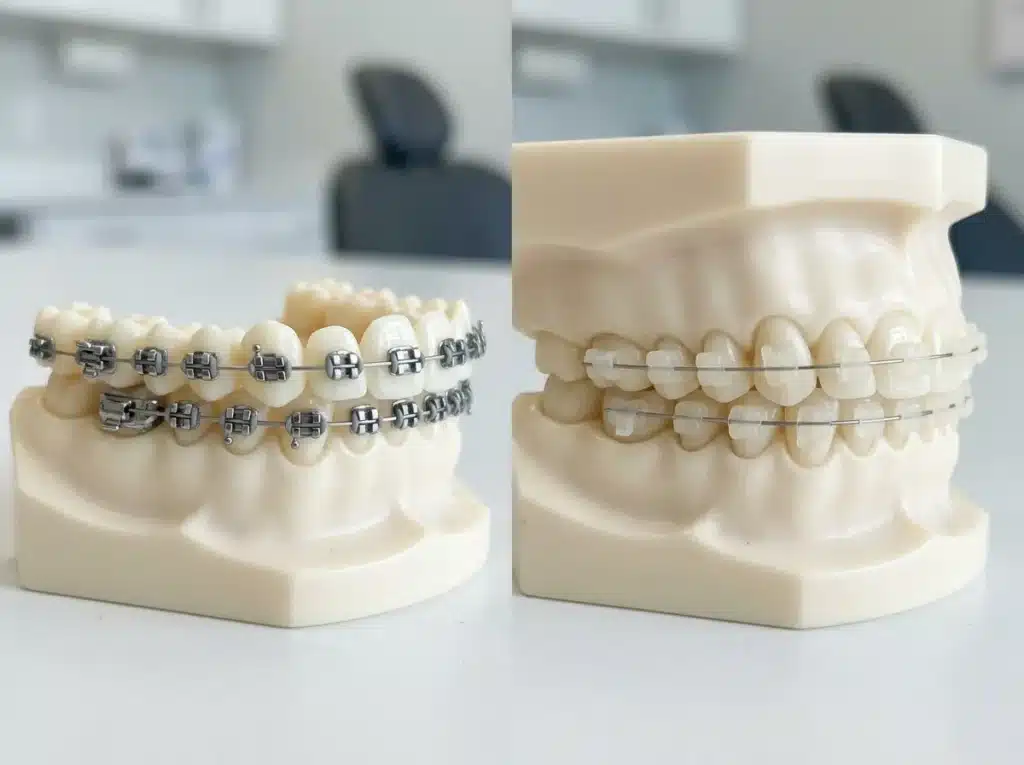
You’ve heard your orthodontist mention LightForce. You’re not sure what it actually is. Is it just marketing for regular braces, or something really different? Here’s the short version. LightForce brackets are 3D-printed and custom-made for each tooth. Traditional brackets come in a handful of stock shapes instead. That one difference changes fit, comfort, and how often you need to come in.
Dr. Derek Pollard, a Certified Specialist in Orthodontics, founded Kelowna Orthodontics. He has spent his career checking new tools before they reach patients. He leads two groups: the Kelowna Orthodontic Study Club and the Okanagan Orthodontic Specialists Society. His practice tested LightForce’s fully personalized 3D-printed bracket system first. It had to pass that same test before he brought it in. This guide walks through what changes between LightForce, traditional braces, and Invisalign, and what stays the same.
Key takeaways if you’re comparing LightForce, traditional braces, and Invisalign
- LightForce brackets are custom 3D-printed for each tooth, while traditional brackets are mass-produced in stock shapes.
- LightForce reports up to 60 percent fewer appointments and up to 43 percent shorter treatment, based on its own published data.
- A 2024 study in the Journal of Clinical Orthodontics found LightForce patients averaged 8 to 11 visits, versus 12 to 15 for traditional braces.
- Invisalign stays removable and nearly invisible, but LightForce and traditional braces handle more complex bite problems.
- Book a consultation to find out which of the three actually fits your child’s bite, or your own.
What is LightForce, and how is it different from a regular bracket?
LightForce brackets start with a 3D scan of your teeth. There is no putty tray involved. Software then designs a bracket shaped for that exact tooth. It is not a generic mold pulled off a shelf. Each bracket gets 3D-printed to match your bite before your orthodontist ever touches a wire. Traditional brackets are not the same. They come from a set of standard sizes, and your orthodontist bends and adjusts the wire instead, throughout treatment, to help them fit.
That custom fit is the whole point. A bracket built for your own tooth sits flatter against the enamel. It needs fewer fixes along the way, since the shape already matches. Kelowna Orthodontics uses the same digital scan for LightForce that it uses for Invisalign, called iTero. There is no putty tray at your first visit, whichever option you choose.
Ceramic LightForce brackets are also less bulky than standard ceramic or metal brackets. The shape follows your tooth instead of sitting on top of it like a stock piece would. Most patients say they are noticeable but not obvious up close in normal conversation. That is a real difference if you talk to people all day at work or school.
Does LightForce actually mean fewer visits and faster treatment?
LightForce reports up to 60 percent fewer visits. It also reports up to 43 percent shorter treatment time, compared with traditional braces. That figure comes from LightForce’s own published data. It is not a guarantee for every case. A separate 2024 study in the Journal of Clinical Orthodontics looked closer at this. LightForce patients averaged 8 to 11 total visits. Traditional-bracket patients in that same study averaged 12 to 15 visits.
Those numbers describe averages across many patients. They are not a promise for your case. A tooth that needs to rotate a lot still takes real time to fix. A bite with a big jaw problem takes time too, no matter which bracket holds the wire. Ask your orthodontist how your case compares to those averages. Do not assume the shorter end applies to you.
Fewer visits matters most if you are driving in from Vernon, Penticton, or Merritt for every visit. That is where the visit count difference shows up in real life. It is not just a number on a brochure.
LightForce vs. traditional braces vs. Invisalign, side by side
Each option trades off differently on how it looks, how flexible it is, and how complex a case it can handle. The table below lays out the real differences before you weigh cost or timeline.
| LightForce | Traditional braces | Invisalign | |
| Bracket or aligner | Custom 3D-printed ceramic | Stock metal or ceramic | Clear removable aligners |
| Visibility | Low, tooth-coloured | Metal visible, ceramic less so | Nearly invisible |
| Removable | No | No | Yes, worn about 22 hours a day |
| Handles complex bites | Yes | Yes | Best for mild to moderate cases |
| Reported visit frequency | Fewer, per LightForce’s own data | Standard, every 6 to 8 weeks | Fewer in-office checks, more self-monitoring |
Every row in that table depends on your own bite, not just which option you pick in theory. A mild case might suit any of the three. A complex one narrows the field fast. That is exactly why a visit, not a chart, makes the final call.
If you already understand how aligners work, the comparison gets easier. Many parents ask how Invisalign moves teeth in the first place, since it looks so different from a wire and bracket system, and that is worth understanding before you rule either option out.
Who is actually a good candidate for LightForce?
LightForce suits patients who want a fixed appliance, not a removable one, but still want less bulk than standard ceramic braces. It works well for teens and adults with crowding, spacing, or bite issues that need steady force. Complex rotations and real jaw problems are also within its range. That is not always true for Invisalign, which struggles with bigger movements.
It is not the right fit for everyone. Someone who wants to remove their appliance for photos, sports, or meals should look at Invisalign instead. That kind of freedom belongs to removable aligners, not to any fixed bracket system, LightForce included. A patient with several missing back teeth or a lot of past dental work may need a different plan, decided case by case.
Your first visit includes a digital scan and a full review of your bite. Nobody here should suggest LightForce without checking if your case actually benefits from it first.
What does each option cost?
Cost depends heavily on how complex your case is, more than which bracket you choose. LightForce, traditional braces, and Invisalign often land in a similar price range. Treatment length and how often you need to come in both factor into that number. Kelowna Orthodontics offers zero-interest payment plans on every option, split into monthly, quarterly, or custom terms built around your budget. Paying the full fee upfront also earns a 5 percent discount off the total.
Ask for a written quote at your first visit. Do not just compare sticker prices online. Two patients choosing the exact same bracket system can end up with very different totals. Crowding, jaw correction, and total treatment length all shift the final number.
Getting started with LightForce in Kelowna
The only way to know whether LightForce, traditional braces, or Invisalign fits your bite is a visit with a certified specialist. A brochure or a website comparison cannot make that call for you. Dr. Pollard and the other orthodontists here review every new LightForce case personally before it starts. A bracket that fits one bite poorly can slow treatment down instead of speeding it up, so that review matters.
Kelowna Orthodontics sees patients from across the Okanagan, including Vernon, Penticton, and Merritt. You do not need a referral to book that first visit, and free parking is available at the Harvey Avenue office every time you come in.
If you want to know whether LightForce is worth it for your own teeth, call Kelowna Orthodontics at (250) 763-3312. Or book a consultation online and bring your questions about all three options to that first visit.