This decision has a longer reach than most people expect
Orthodontic treatment is not a short commitment. Depending on your case, you could be seeing the same practice every six to eight weeks for one to three years. The orthodontist you choose will be involved in decisions that shape your bite, your facial structure, and the long-term health of your teeth. Getting that choice right matters considerably more than most people think about when they first start searching.
Kelowna has several orthodontic practices, and each has a different approach, a different team, and different capabilities. This guide covers what to actually evaluate so you can make a clear, confident decision for yourself or your child.
Orthodontist vs. general dentist: the difference is real
This is the first and most important distinction to understand. An orthodontist is not simply a dentist who offers braces. After completing dental school, orthodontists undertake an additional two to three years of specialty training focused exclusively on tooth movement, bite correction, and jaw development. That specialized education covers a level of diagnostic precision that general dental training simply does not include.
In Canada, certified specialist orthodontists are recognized under provincial dental licensing bodies. In British Columbia, the College of Dental Surgeons of BC oversees certification for orthodontic specialists. This matters because the quality of your outcome over a multi-year treatment depends directly on the diagnostic depth behind your plan. A properly trained specialist sees the full picture of jaw relationships, growth patterns, and bite function, not just whether the teeth look straight.
When evaluating any practice in Kelowna, ask directly: are the treating doctors certified specialist orthodontists? This is a reasonable question, and any reputable practice will answer it clearly.
What to look for in a Kelowna orthodontist
Credentials and specialty training
Confirm that the orthodontist holds a graduate degree in orthodontics from an accredited program and is registered as a specialist with the BC College of Oral Health Professionals. Membership in professional bodies such as the Canadian Association of Orthodontists, the British Columbia Society of Orthodontists, and the American Association of Orthodontists signals ongoing engagement with current standards of care and continuing education.
A full range of treatment options
A practice that offers only one treatment approach is not necessarily right for your case. Look for a clinic that offers:
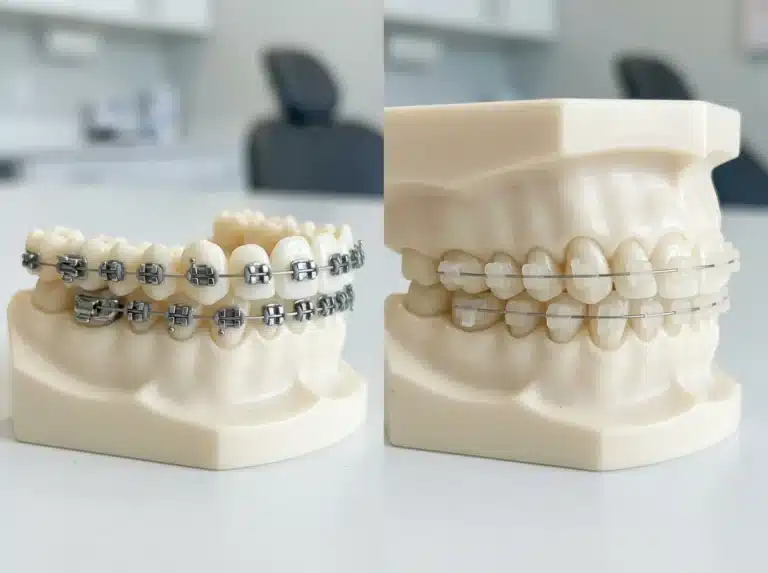
- Traditional metal braces for cases requiring the most precise control
- Clear ceramic braces for patients who prefer lower visibility
- Invisalign clear aligners for those seeking a removable, discreet option
- Early intervention treatment for children with developing bite or jaw issues
- Growth modification appliances when needed
- Retention planning after active treatment ends
The right treatment for your case is determined by your specific bite, crowding, jaw relationship, and age, not by what is easiest to offer or most heavily promoted. A practice that offers the full spectrum of options can match the treatment to you, not the other way around.
Modern diagnostic technology
Orthodontic technology has changed significantly over the past decade. Practices using current tools can plan more precisely, communicate more clearly, and, in many cases, reduce discomfort at appointments.
Look for iTero digital scanning, which replaces old physical impressions with a comfortable, accurate 3D scan of your teeth. This scan also generates a simulated preview of your treatment outcome before you commit. Digital X-rays and imaging that support comprehensive diagnosis of jaw and bite relationships are also standard at quality practices.
Technology does not replace clinical skill. But a practice that invests in modern tools is usually one that also invests in training and stays current with the field.
Transparent communication and honest treatment planning
One of the most consistent things patients say about good orthodontic practices is that they felt informed. Not just at the consultation, but throughout treatment. Every adjustment appointment should include a brief explanation of what was done and what comes next. Parents should not have to rely on their child to relay information about their treatment.
During a consultation, pay attention to whether the orthodontist takes time to explain your diagnosis clearly, presents more than one option where applicable, is upfront about realistic timelines and costs, and answers your questions without making you feel rushed.
A practice that communicates well from the start tends to communicate well throughout treatment.
Financial clarity and payment flexibility
Orthodontic treatment is a meaningful investment. Total costs vary depending on case complexity and treatment type. Before starting, you should have a written breakdown of total fees, what is included, how your insurance benefit applies, and what payment plan options are available.
Ask about zero-interest payment arrangements. Many quality practices in Kelowna offer these to make treatment accessible without requiring full payment upfront.
If a practice is vague about costs before you sign anything, that is worth noticing.
When should you start?
For children, the Canadian Association of Orthodontists recommends a first orthodontic assessment around age seven. At this stage, an orthodontist can identify developing issues with jaw growth or tooth eruption that are far easier to address while growth is still underway. Early assessment does not always mean early treatment. In many cases, the orthodontist monitors development until the right window opens.
For teens, treatment typically begins once most permanent teeth have erupted. For adults, there is no upper age limit on orthodontic treatment. Bone is less responsive than in younger patients, which can affect treatment timelines, but consistently good results are achievable at any age.
Why Kelowna families choose Kelowna Orthodontics
Kelowna Orthodontics, located at 102-110 Harvey Ave, Kelowna, BC, is led by certified specialist orthodontists Drs. Derek Pollard, Diego Diaz, and Jessica Kehler. Dr. Pollard holds a Master’s degree in Orthodontics and Dentofacial Orthopedics from the University of Manitoba. Dr. Kehler graduated from UBC with her MSc in Craniofacial Science and a Diploma in Orthodontics and is a Fellow of the Royal College of Dentists of Canada. She is a member of the Canadian Association of Orthodontists, the BC Society of Orthodontists, and the American Association of Orthodontists.
The practice uses iTero digital scanning, offers the full range of treatment options, including Invisalign and traditional braces, and provides zero-interest payment arrangements. Free consultations are available for new patients.
Kelowna Orthodontics serves families across the Central Okanagan, from Penticton to Vernon, Merritt to the Kootenays.
Book your free consultation in Kelowna
Choosing the right orthodontist in Kelowna starts with meeting the team, understanding your options, and asking the questions that matter to you. At Kelowna Orthodontics, consultations are complimentary and carry no obligation.
Call (250) 763-3312 or visit kelownabraces.ca to request your appointment online.